
PokerStars Trinidad and Tobago: Legitimacy Check

Amber · the local authorisation and player outcome are not established
PokerStars is not proven to be locally licensed for Trinidad and Tobago. The supplied records do not establish a Trinidad and Tobago authorisation for pokerstars.com, and they do not provide a blanket ruling that determines every player’s legal position. PokerStars’ published terms describe location-based restrictions, account checks and withdrawal rules, but they do not confirm that a Trinidad and Tobago account can deposit, play or withdraw successfully. The evidence signal is therefore amber.
Verdict at a glance
The distinction matters. An established international brand, a functioning website or a foreign-market authorisation would not by itself establish permission to offer online gambling locally. Equally, the absence of a supplied local licence record is not evidence that every interaction is unlawful or that the operator is a scam.
The available material supports a narrower conclusion: local regulatory implementation remains incomplete, online betting is not presently contemplated under the cited framework, and PokerStars’ operator-level documents leave Trinidad and Tobago outcomes unresolved. No account registration, deposit, casino game, poker game or withdrawal was tested.
Exact domain and product identity
The assessment is limited to pokerstars.com. Lookalike hosts, shortened links, advertisements, social accounts and similarly named services are outside the evidence. Confirming the host before entering credentials or payment information is essential because conclusions about one domain cannot safely be transferred to another.
PokerStars is associated with both poker and casino products. That shared brand identity does not mean every product has identical location rules. Restrictions may operate at the account level, across the wider service, or for particular games and providers. No game-provider restriction record specific to Trinidad and Tobago was supplied.
| Identity check | Evidence available | What remains unproven |
|---|---|---|
| Exact host | pokerstars.com is the domain under review. | Other hosts or applications are not authenticated by this finding. |
| Product identity | The focus covers PokerStars poker and casino products. | Availability of either product in Trinidad and Tobago is not confirmed. |
| Published documents | General terms and help material describe account, KYC and withdrawal processes. | General documents are not a local licence or eligibility decision. |
| Practical testing | No test result was supplied. | Registration, deposits, play and withdrawals remain unverified. |
What the Trinidad and Tobago regulator records establish
The Gambling Control Commission says Parts I, II and X of the Gambling Control Act 2021 are in force and states that provisions dealing with licensing, regulation, compliance and enforcement have not yet been proclaimed. However, Legal Notice 700/2026 separately brought section 76 and Schedule 6, in their application to section 76, into force on 15 September 2026. These records do not proclaim the entire Act, establish a complete licensing regime or authorise PokerStars; section 76 concerns specified conduct involving prohibited territory outside Trinidad and Tobago and should not be treated as a blanket rule for TT players.
The Commission’s official FAQ says online betting is not presently contemplated under the Act and that further guidance will follow. Nothing in the supplied Commission material identifies pokerstars.com as locally licensed, approved or assessed as safe.
The Remote Gambling Order PDF was laid before Parliament in September 2026 and is subject to affirmative resolution. The available copy has blank House and Senate approval dates. It refers conditionally to holders of a valid Commission remote licence, but the PDF alone does not establish final approval, an effective remote-licensing route or a Trinidad and Tobago licence for PokerStars.
| Jurisdiction question | Documented position | Evidence limit |
|---|---|---|
| Are key local licensing provisions in force? | The Commission says licensing, compliance and enforcement provisions have not yet been proclaimed. | This does not create a brand-specific approval or prohibition. |
| Does the Act presently contemplate online betting? | The Commission FAQ says it does not at this time and that guidance will follow. | The FAQ is not a ruling on an individual player or transaction. |
| Does PokerStars have a supplied Trinidad and Tobago licence? | No brand-specific local licence record was supplied. | Foreign status cannot fill that evidential gap. |
| Is the September 2026 order effective? | The available copy has blank approval fields. | It is not relied upon as operative law. |
| Are local player outcomes confirmed? | No local account or payment test exists. | Access and transaction results remain unknown. |
For a broader explanation of the developing framework, consult the licence and law guide.
Compare a separate alternative
Foreign claims and local legality are separate questions
No foreign licence evidence was included in the accepted records. Even if a foreign authorisation were established, it would show only what the relevant foreign regulator permits for the licensed entity and market. It would not prove local authorisation, local consumer protection or eligibility for a person resident in Trinidad and Tobago.
The same caution applies to restricted-territory lists. Absence from a published restriction list is not equivalent to express acceptance. General terms may reserve the operator’s ability to apply country, account or product restrictions, and the rules presented during registration may change according to residence.
There are therefore several distinct questions: whether the domain belongs to the intended operator, whether an account may be opened, whether particular games may be accessed, whether a payment method is available, and whether local law permits the activity. Evidence for one question should not be presented as an answer to all five.
Account eligibility and identity checks
PokerStars says identity, age and address verification may be required at any stage. The documents requested can vary according to the account and jurisdiction. This is an operator statement about its general process, not evidence that documents from Trinidad and Tobago will be accepted or that verification will be completed within a particular time.
Before depositing, the account name, date of birth, residential address and payment ownership details should be accurate and consistent. A discrepancy can create avoidable questions when identity or payment ownership is reviewed. Never use another person’s payment instrument, submit altered records or provide a password in response to a verification request.
- Read the terms and location notices displayed for the actual account.
- Check whether poker and casino access are treated separately.
- Keep dated copies of requested documents and submission confirmations.
- Redact information only where the stated verification instructions allow it.
- Do not interpret initial registration access as final eligibility approval.
The available evidence does not establish the precise documents, processing time or decision that a Trinidad and Tobago player would encounter.
How PokerStars describes withdrawal routing
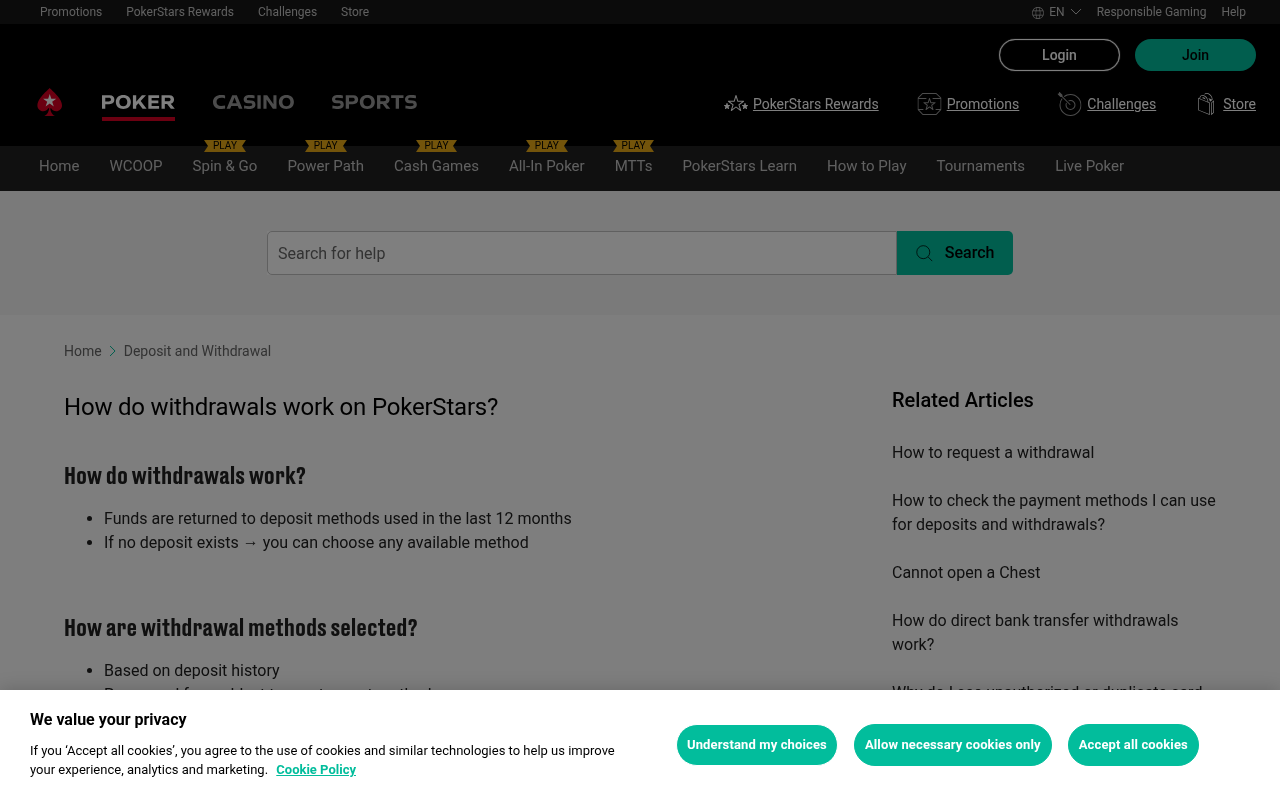
PokerStars says available withdrawal methods depend on location and deposit history. Its published process ordinarily returns funds to the original deposit methods before another eligible route is used. That method-return rule is important because the withdrawal screen may not simply offer every payment option associated with the account.
The operator material does not identify a confirmed Trinidad and Tobago cashier, supported local banking route, currency-conversion outcome or processing time. No specific card, bank, wallet or other method should be assumed available. A deposit method appearing during one session would also not prove that every withdrawal can use the same route without further checks.
Before funding an account, establish what the cashier actually shows for the verified country of residence. Read any method-return explanation, limits and verification notice presented before confirming the transaction. Save the deposit reference and the displayed account balance. General guidance on comparing transaction risks is available in the payments guide.
Most importantly, the published withdrawal process is not a successful-withdrawal test. It describes what PokerStars says should happen under its rules; it does not establish what happened to a Trinidad and Tobago customer.
Practical checks before depositing
A careful decision should be based on records visible for the specific account rather than reputation alone. The following checklist separates questions that can be documented from outcomes that remain unknown.
| Stage | What to document | Why it matters |
|---|---|---|
| Domain check | Record the exact host and reject misspellings or unexpected redirects. | The evidence applies only to pokerstars.com. |
| Country setting | Confirm that the true country of residence is selected and accepted. | General terms describe geographical restrictions. |
| Product access | Check poker and casino availability independently. | Site-wide and game-level restrictions may differ. |
| Account terms | Save the dated terms and notices accepted during registration. | General public terms may not reveal every account-specific condition. |
| KYC | Identify required proof of identity, age and address before funding. | Verification may be requested at any stage. |
| Cashier | Record the methods, limits, currency and method-return notice actually displayed. | No Trinidad and Tobago payment route is confirmed by the evidence. |
| Deposit | Keep the transaction reference, amount, date and payment ownership record. | Deposit history can affect withdrawal routing. |
| Withdrawal | Save the request reference, status messages and any further document request. | No successful local withdrawal test exists. |
| Support | Keep complete correspondence and case numbers. | A clear chronology helps if a dispute develops. |
If an account or withdrawal problem develops
Start by preserving evidence rather than making a public accusation. Record the balance, transaction references, dates, terms accepted, verification requests and the operator’s written responses. Describe what occurred without labelling conduct fraudulent unless a competent record establishes that conclusion.
Ask support to identify the exact rule being applied, the outstanding document or action, and the status of the withdrawal. If the answer refers to a geographical or product restriction, request the relevant wording. Do not send passwords, one-time codes or unrestricted financial records through an unverified channel.
Before approaching any outside dispute body, identify the contracting entity and complaint route stated in the accepted terms. The evidence packet does not establish which foreign regulator or dispute service, if any, would accept a Trinidad and Tobago complaint. A bank or payment provider can explain its own dispute process, but the transaction should be described accurately and supported with records.
For documentation steps and warning signs, use the complaints and scam warnings guide. No verified complaint volume, individual complaint outcome or official adverse finding against PokerStars was supplied.
Risk controls and responsible play
Unresolved local status and untested payments justify a cautious approach. Do not deposit money needed for bills, assume displayed balances are immediately withdrawable, or increase spending in an attempt to recover losses. Set a firm limit before any gambling activity and stop if account access, identity checks or payment rules are unclear.
Gambling controls do not resolve a licensing question, but they can reduce personal harm. Information on limits, breaks and support options is available through responsible gambling support. Anyone facing immediate financial or emotional harm should prioritise support over account recovery or further play.
Frequently asked questions
Is PokerStars legit in Trinidad and Tobago?
The evidence does not confirm that pokerstars.com is locally licensed in Trinidad and Tobago. Official records show an incomplete licensing framework, while PokerStars’ general terms leave local access and transaction outcomes unresolved. The appropriate signal is amber rather than a claim of approval, prohibition or fraud.
Does PokerStars hold a Trinidad and Tobago gambling licence?
No brand-specific Trinidad and Tobago licence record for pokerstars.com was supplied. The Gambling Control Commission says key licensing provisions have not yet been proclaimed, and its current website does not identify PokerStars as a locally authorised operator.
Can a Trinidad and Tobago resident open a PokerStars account?
The available evidence does not confirm account eligibility. PokerStars describes geographical restrictions in its general terms, but those terms are not a Trinidad and Tobago acceptance notice. Registration access alone should not be treated as final approval for deposits, games or withdrawals.
How do PokerStars withdrawals work?
PokerStars says methods depend on location and deposit history and that funds are ordinarily returned to original deposit methods. No method, processing time or successful withdrawal has been verified for Trinidad and Tobago.
What verification can PokerStars request?
PokerStars says it may request proof of identity, age and address at any stage. Requirements vary by account and jurisdiction, so the available material does not establish which documents a Trinidad and Tobago player would need or whether they would be accepted.
What should I do if a withdrawal or account is restricted?
Save transaction references, balances, terms, verification requests and support replies. Ask for the precise rule and outstanding action in writing. Do not share passwords or one-time codes, and do not describe the issue as fraud without competent supporting evidence.