
Betway in Trinidad and Tobago: identity, licence and risk check
The name Betway, the company Betway Limited and the internet address betway.com are three separate identity elements. They should not be treated as interchangeable. The supplied material confirms that the exact domain presents the service and that UKGC account 39372 lists that domain, but the foreign record is not authorisation for Trinidad and Tobago.
No current primary Trinidad and Tobago record in the verified packet matches the exact domain to the named operator. The Gambling and Gaming Commission of Trinidad and Tobago also states that online betting is not presently contemplated and that further guidance will follow. Those gaps require an amber signal: there is meaningful identity evidence, but not enough local primary evidence for a green conclusion.

Brand, company and exact domain
A reliable identity check begins with the address bar rather than a familiar colour scheme, advertisement or search result. The exact domain in the packet is betway.com. It presents the service, but presentation alone cannot prove which company controls a transaction, whether access is intended for a person in Trinidad and Tobago, or which regulator would accept a dispute.
The named company is Betway Limited. The supplied foreign licence description says UKGC account 39372 lists betway.com. That creates a relevant domain-to-record connection within the scope of that foreign record. It does not close the separate Trinidad and Tobago question, and it should not be extended to a different spelling, subdomain, application, payment descriptor or company name.
| Identity layer | Verified packet says | What remains unresolved |
|---|---|---|
| Brand | The service uses the Betway name | A copied name or logo can appear on an imitation |
| Company | Betway Limited is the named operator | No current primary local record in the packet matches it to the exact domain |
| Domain | betway.com presents the service | Presentation does not by itself prove ownership, local availability or safety |
| Foreign licence record | UKGC account 39372 lists the exact domain | It is not Trinidad and Tobago authorisation |
Before entering credentials, compare all four layers. A mismatch at any layer should stop registration or payment until it is explained through verifiable records.
What the licence record does and does not establish
The foreign licence information is useful because it is more specific than a general claim that a business is “licensed”. It identifies an account number and connects the stated domain with a named foreign regulatory framework. Its evidential value remains jurisdiction-scoped: it cannot be converted into a local licence merely because the same website can be reached from Trinidad and Tobago.
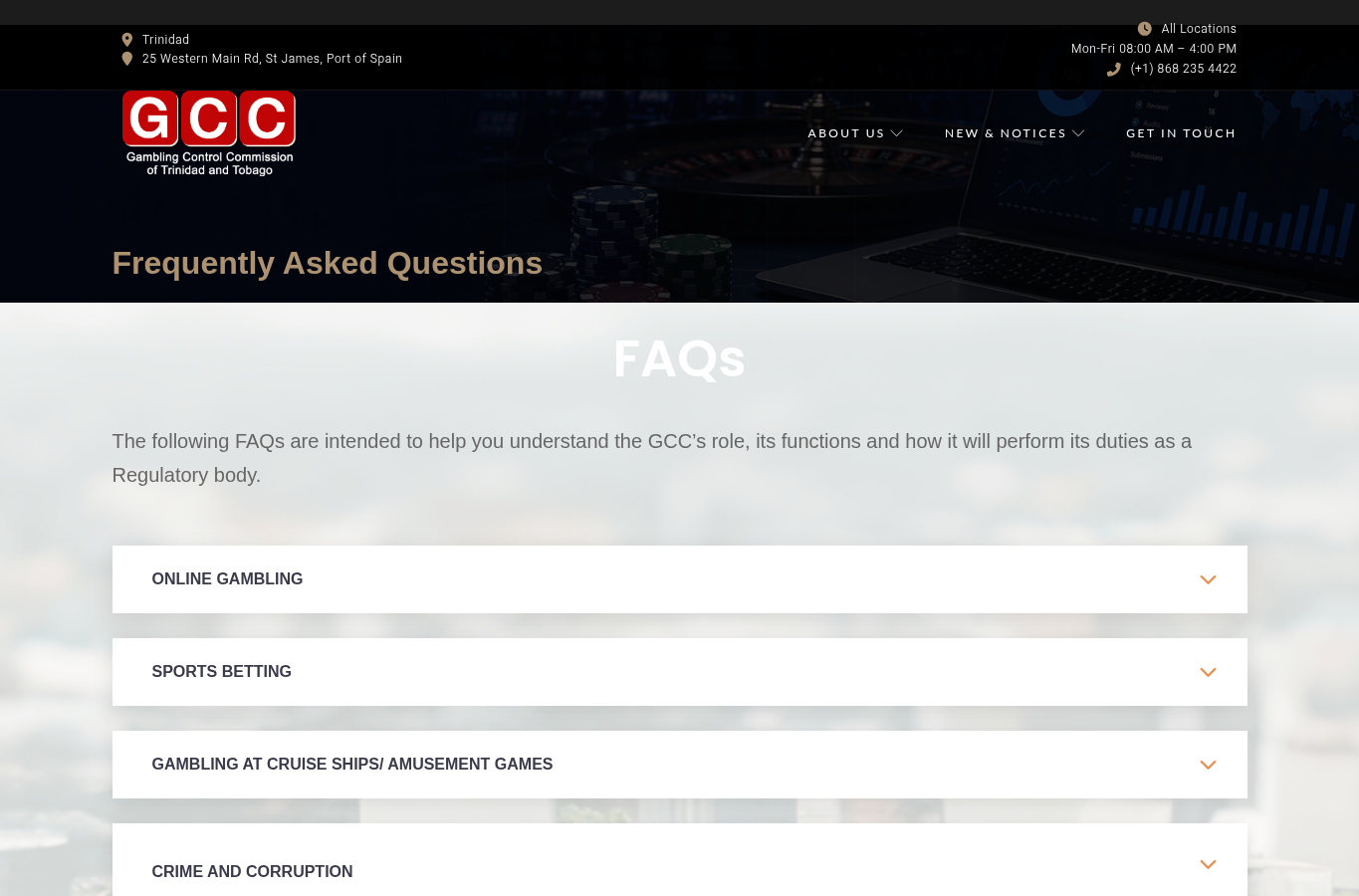
The local position in the packet is more limited. The Commission’s published online-betting guidance says online betting is not presently contemplated and that further guidance will follow. The official Gambling, Gaming and Betting Control Act, 2021 entry confirms Act No. 8 of 2021, its assent and an official download entry. Neither supplied fact identifies the exact domain or Betway Limited as locally authorised.
| Question | Evidence-led answer | Confidence boundary |
|---|---|---|
| Is the exact domain listed in the supplied foreign record? | Yes, under UKGC account 39372 | Foreign and jurisdiction-specific |
| Is that a Trinidad and Tobago licence? | No | The packet expressly distinguishes it from local authorisation |
| Is there a current local record matching the domain and company? | None is supplied | Absence from this packet is not proof that no other record exists |
| Is the local online-betting position fully settled here? | No | The Commission says further guidance will follow |
For a broader explanation of how local and foreign records differ, see licence and law.
Scam, legitimate service and the amber conclusion
The available evidence does not justify calling the service a scam. The exact domain is associated with a functioning branded service, and the supplied foreign account description creates a specific identity link. Equally, those points do not justify an unqualified “legitimate in Trinidad and Tobago” verdict. Local authorisation, local recourse and practical payment handling remain open.
“Is Betway a scam or legit?” therefore needs a divided answer. The identity evidence is stronger than a logo or promotional claim, but the legal and consumer-remedy questions depend on jurisdiction. A foreign licence can support an identity check within its own scope without resolving whether a resident of Trinidad and Tobago is accepted lawfully, protected locally or able to pursue a complaint through a local authority.
| Signal component | Assessment | Reason |
|---|---|---|
| Exact-domain identity | Supported with limits | The service appears at the stated domain, and the packet describes a foreign account listing |
| Trinidad and Tobago authorisation | Open | No current primary local match is supplied |
| Scam allegation | Not established | No official adverse record or corroborated documented evidence is supplied |
| Consumer recourse | Unclear | No tested complaint outcome or confirmed local recipient is included |
| Overall signal | Amber | Material evidence exists, but local status and practical outcomes remain unresolved |
Amber is not a recommendation and not an accusation. It means a player must not substitute overseas identity material for local permission or assume that an unresolved complaint would have a clear recipient.
Payments, card descriptors and ownership checks
No deposit was made and no payment method was tested. The packet does not establish which cards, bank transfers, wallets, currencies, fees, limits or processing times are available to a customer in Trinidad and Tobago. A payment logo displayed during registration would be an operator statement, not proof that the method will work, that a bank will approve it or that withdrawals will return through the same route.
The Central Bank’s payment-system publication supports local card and payment-system terminology. It does not verify this operator’s cashier. Its proper role is to help distinguish local payment concepts from claims made at a gambling checkout.
Before paying, record the exact domain, company named in the terms, transaction currency, proposed fee, card or account owner, and expected statement descriptor. The payment recipient deserves particular attention: a new company name, unrelated domain or unexplained third-party beneficiary breaks the identity chain.
| Payment checkpoint | Acceptable evidence to seek | Reason to pause |
|---|---|---|
| Recipient | Company identity consistent with the verified service records | Unrelated person or unexplained company |
| Currency | Currency and conversion terms shown before confirmation | Conversion disclosed only after submission |
| Fees | Amount and fee displayed clearly | Undefined processing or release charge |
| Card handling | Recognisable secure bank authorisation flow | Request to send card details through messages |
| Refund or reversal | Written terms identifying the responsible party | Promise without a named recipient or process |
General payment precautions are available under payments. Never send additional money solely because someone claims it is required to “unlock” a balance or release a prize; that demand is not supported by the verified packet.
Withdrawals and identity verification
There was no account test, deposit, withdrawal request or identity-verification exercise. Consequently, no claim can be made about withdrawal speed, approval rates, document handling, source-of-funds checks or whether a particular customer would pass verification. User comments cannot fill that gap because they do not establish another customer’s facts or the operator’s response.
A cautious customer should review withdrawal and verification terms before depositing, not after a balance is created. Useful questions include whether withdrawals must return to the deposit method, whether the account name must match the payment instrument, which documents may be requested, how document retention is described, and which company receives personal information. The packet supplies no answers to those operational questions.
| Stage | Record to retain | Unresolved risk here |
|---|---|---|
| Registration | Date, exact domain and accepted terms | Local eligibility was not tested |
| Deposit | Receipt, currency, fee and recipient descriptor | No payment route was tested |
| Verification | Request wording and secure submission location | Document requirements are unknown |
| Withdrawal | Amount, method, timestamp and stated status | Timing and approval behaviour are unknown |
| Escalation | Case number and complete correspondence | No complaint outcome was tested |
Identity checks can be legitimate compliance controls, but an unexpected request should still be verified within the authenticated account. Credentials, one-time passcodes and full payment-card details should not be sent to a person who approaches through social media or messaging.
Complaints and the correct recipient
A useful complaint must identify both the transaction counterparty and the disputed event. Start with the support route available inside the authenticated service, preserve the case number, and state the dates, amounts, currency and requested remedy. Do not rely on a public comment as the only record.
If the response is inadequate, determine which entity accepted the wager or payment and which licence terms are said to apply. The foreign record described in the packet may be relevant only within its jurisdictional and entity scope. The local Commission’s present guidance does not supply a confirmed route for a complaint about this exact online domain. That uncertainty should be acknowledged rather than replaced with an assumed regulator.
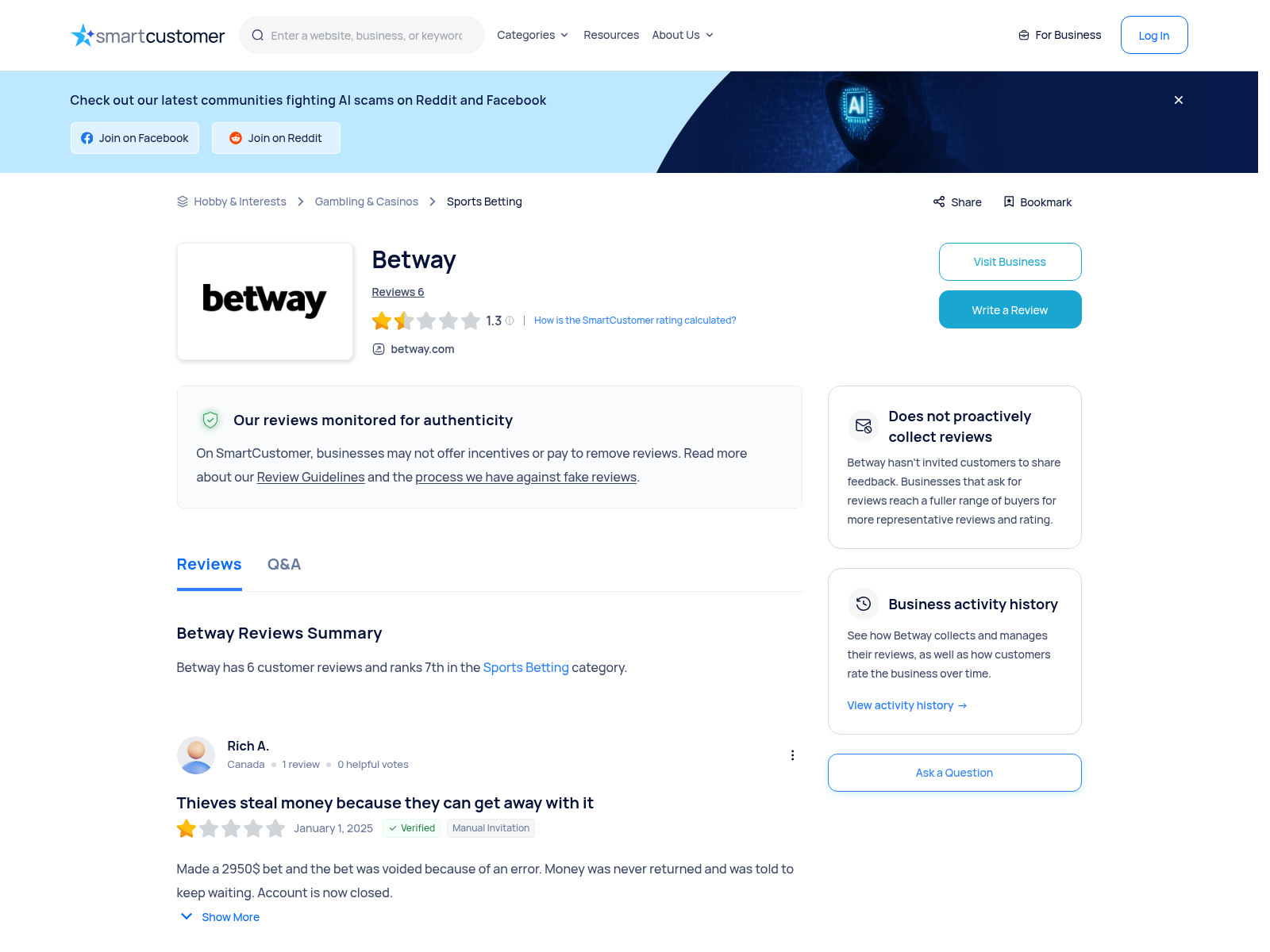
Independent reviews are contextual. The supplied Sitejabber record establishes that a review page for betway.com was available when checked; individual allegations, ratings and identities were not verified and are not proof of a general practice.
For a structured record of the issue, use the steps under complaints and scam warnings. If gambling is causing immediate financial or personal harm, use urgent help rather than continuing play while a dispute is unresolved.
Clone and impersonation checks
A clone can reproduce a name, logo, colour palette and even copied licence wording. The strongest defence is to verify the complete domain and its connection to the company before signing in. The approved identity reference here is betway.com; a lookalike spelling, added word, unfamiliar country ending or link sent by an unknown person is not covered by the supplied evidence.
Check the address after every redirect. A secure-connection icon only indicates an encrypted connection to the displayed domain; it does not prove that the recipient is the intended company. Search advertisements and social profiles can also point elsewhere, so neither should replace direct domain verification.
Pause immediately if a supposed representative asks for a password, one-time passcode, remote access, cryptocurrency transfer, gift card, personal-account payment or a fee to release winnings. The packet does not establish any such procedure. Also pause when the cashier names a recipient that cannot be reconciled with the service’s stated company.
The safest comparison uses four fields: exact domain, named company, relevant licence account and payment recipient. All four should tell one coherent identity story. If they do not, preserve screenshots and transaction records, avoid further payment and follow the complaint guidance.
Evidence chronology, limits and correction path
All cited records and captures were checked on 24 August 2026. The chronology matters because regulatory guidance, domain control, corporate arrangements and payment availability can change. A dated finding should not be read as permanent.
| Date checked | Record | Supported point | Does not support |
|---|---|---|---|
| 24 August 2026 | Commission FAQ | Online betting is not presently contemplated; further guidance will follow | Local approval for the exact domain |
| 24 August 2026 | Parliament publication entry | Act No. 8 of 2021, assent and official download entry | A domain-specific licence decision |
| 24 August 2026 | Central Bank publication | Local payment-system terminology | Availability or success of an operator payment method |
| 24 August 2026 | Exact operator domain | The domain presents the branded service | Ownership, local legality or safety by itself |
| 24 August 2026 | Independent review capture | A user-review context exists | Proof that allegations or ratings are accurate |
The method separates primary public records, operator presentation and user context. It gives greater weight to a competent primary record, restricts foreign material to its jurisdiction, and leaves unknown matters open. No personal play experience, account opening, payment test, withdrawal test or complaint test was used. More detail on the standard is available under methodology.
A correction should identify the precise statement, provide a dated primary record or complete documentary support, and explain the domain and entity connection. Submissions can be made through contact. Promotional claims, undated screenshots and isolated user comments may prompt checking, but they cannot independently establish local authorisation or misconduct.
Practical conclusion before deciding
The most defensible conclusion is narrower than either “safe” or “scam”. The identity packet connects Betway Limited, betway.com and a stated UKGC account within a foreign regulatory context. It does not contain a current primary Trinidad and Tobago record authorising that exact company-domain combination. The local Commission’s own guidance leaves the online-betting position awaiting further guidance.
Anyone considering the service should verify the full domain, read the applicable company and jurisdiction terms, identify the payment recipient, understand verification requirements and confirm a realistic complaint route before depositing. A mismatch or unexplained gap should be treated as a stop signal. Anyone already facing harm should prioritise responsible gambling support over attempts to recover losses through further wagering.
The commercial route above is not a finding of local authorisation and does not change the amber assessment.
Frequently asked questions
Is Betway a scam or legitimate?
The verified packet does not establish a scam. It connects the exact domain with the branded service and describes a foreign UKGC account listing, but it does not establish local authorisation, tested withdrawals or a confirmed Trinidad and Tobago complaint route. The appropriate conclusion is amber, not an unconditional endorsement or accusation.
Is Betway legal in Trinidad and Tobago?
No current primary Trinidad and Tobago record supplied here matches betway.com and Betway Limited. The Gambling and Gaming Commission says online betting is not presently contemplated and that further guidance will follow. The foreign UKGC record is not Trinidad and Tobago authorisation.
Which domain was checked?
The exact domain checked was betway.com. A different spelling, added word, unfamiliar subdomain or other domain ending is outside the supplied identity evidence and should be treated as unverified until independently matched to competent records.
Were deposits or withdrawals tested?
No. There was no account opening, deposit, payment, identity-verification or withdrawal test. Available methods, fees, processing times, document requirements and withdrawal outcomes for customers in Trinidad and Tobago therefore remain unknown.
Where should a complaint be sent?
Begin with the support channel inside the authenticated service and retain the case number and complete records. Then identify the company that accepted the transaction and the jurisdiction stated in the applicable terms. The packet does not confirm a local regulator complaint route for this exact online domain.
Do user reviews prove that the service is safe or fraudulent?
No. The supplied independent review capture establishes only that a review context was available. Ratings, identities and allegations were not verified, may concern different circumstances, and cannot prove either general safety or misconduct.
Trinidad and Tobago Police Service
WiPay Trinidad and Tobago