
Is 20Bet Legit for Trinidad and Tobago Players?
Amber · the local authorisation and player outcome are not established
20Bet cannot presently be confirmed as locally licensed or locally tested for Trinidad and Tobago. Commission material says key licensing provisions remain unproclaimed and online betting is not presently contemplated under the Act. The operator publishes general withdrawal and KYC guidance, but that does not prove a working Trinidad and Tobago cashier or a successful local payout.
Evidence verdict: amber, not a local approval
The amber signal reflects an open evidence gap rather than proof that 20Bet is fraudulent or proof that it is lawful for local play. No supplied primary record grants 20bet.com a Trinidad and Tobago operator licence. There is also no documented account test, deposit test, withdrawal test or case record establishing how the service treats a player resident in Trinidad and Tobago.
The Gambling Control Commission’s published status material says Parts I, II and X are in force while remaining licensing and regulatory provisions have not yet been proclaimed. Its FAQ separately says online betting is not presently contemplated under the Act and that further guidance will follow. These are broad statements about the local framework, not a finding about one foreign website.
Parliament records House approval of the Remote Gambling Order on 30 September 2026. A Senate agenda published for 2 October lists debate on that Order as expected. An agenda does not establish what happened after publication, and neither parliamentary record operates as a licence for a named casino domain. Readers who need the wider framework can consult the local licence and law guide.
| Question | Evidence available | What it establishes | What remains unproven |
|---|---|---|---|
| Is the reviewed identity 20Bet? | The exact domain under review is 20bet.com. | It fixes the identity that must be checked. | It does not establish ownership, local authorisation or eligibility. |
| Is there local regulatory support? | Commission status and FAQ material describe the general legal position. | Core licensing provisions remain unproclaimed, and online betting is not presently contemplated under the Act. | No supplied record names 20bet.com as locally licensed. |
| Has remote-gambling legislation advanced? | The House approved an Order on 30 September; a Senate agenda listed expected debate on 2 October. | The subject was moving through Parliament. | The agenda does not prove the Senate outcome, commencement or operator approval. |
| Are withdrawals explained? | 20Bet publishes general withdrawal guidance. | The operator describes KYC, wagering checks, method-dependent cashouts and possible delays. | No successful Trinidad and Tobago withdrawal is documented. |
What the Trinidad and Tobago records actually say
The strongest evidence in the record comes from official local bodies. The Gambling Control Commission’s status material, checked on 2 October 2026, describes only Parts I, II and X as being in force and says the remaining licensing and regulatory provisions have not yet been proclaimed. That wording does not create an operator-specific authorisation for 20Bet or any other named foreign casino.
The Commission’s official FAQ says online betting is not presently contemplated under the Act and that further guidance will follow. This is important because availability and legality are different questions. A website may load, allow registration or display games without an official local record establishing that the operator is licensed for Trinidad and Tobago.
The record should also be read with its date in mind. It captures what the cited official pages said on 2 October 2026. It should not be stretched into a permanent conclusion about future legislation, proclamations or guidance. A later official instrument could change the framework, but no such later evidence is included here.
What the Remote Gambling Order does—and does not—prove
The Parliament record shows House approval of the Gambling (Gaming and Betting) (Remote Gambling) Order on 30 September 2026. That is a meaningful legislative event, but it is not interchangeable with commencement, detailed licensing rules or a licence issued to 20bet.com.
The supplied Senate sitting record is an agenda saying debate was expected on 2 October. It does not record an outcome in the evidence packet. It would therefore be inaccurate to say that the Senate approved or rejected the Order, or that a complete remote-gambling licensing system was operational, solely on the strength of that agenda.
Even a completed general legislative process would not automatically authorise every offshore operator. A reliable brand-level conclusion would still require a competent official record connecting the exact legal entity and exact domain to permission covering the relevant activity. No such record for 20Bet has been supplied.
| Area | Current documented position | Safe conclusion for 20Bet |
|---|---|---|
| Trinidad and Tobago | Commission material describes incomplete proclamation of licensing provisions and says online betting is not presently contemplated. | Local authorisation for 20bet.com is not established. |
| House proceedings | House approval of the Remote Gambling Order is recorded for 30 September 2026. | This is legislative evidence, not a casino licence. |
| Senate proceedings | The 2 October agenda lists expected debate. | No outcome should be inferred from the agenda alone. |
| Foreign jurisdictions | No accepted foreign licence record is included in the evidence packet. | No foreign licensing claim can be verified here; even one would not prove local legality. |
| Operator access | General country-dependent payment guidance exists. | Access, player eligibility and local cashier support remain unknown. |
Exact-domain checks matter before registration
A review of 20Bet must stay tied to 20bet.com. Similar names, advertisements, search results, mirror addresses and third-party references cannot substitute for evidence about the exact host. A licence or policy associated with another domain or another legal entity would not automatically cover the reviewed website.
The supplied records do not establish the operator’s legal entity, a licence number, a registered address or a local representative. Those details should not be guessed from branding. If a player sees a licence claim during registration, the useful check is whether the issuing authority’s own current register connects that licence, legal entity and exact domain. A badge or footer statement hosted by the casino is an operator claim until independently confirmed.
Likewise, the ability to select Trinidad and Tobago, enter a local phone number or reach a deposit screen is not regulatory evidence. A foreign site’s restricted-territory list can change, may apply differently across products, and does not decide what local law permits. Absence from such a list proves neither eligibility nor protection.
Withdrawal guidance versus a verified local payout
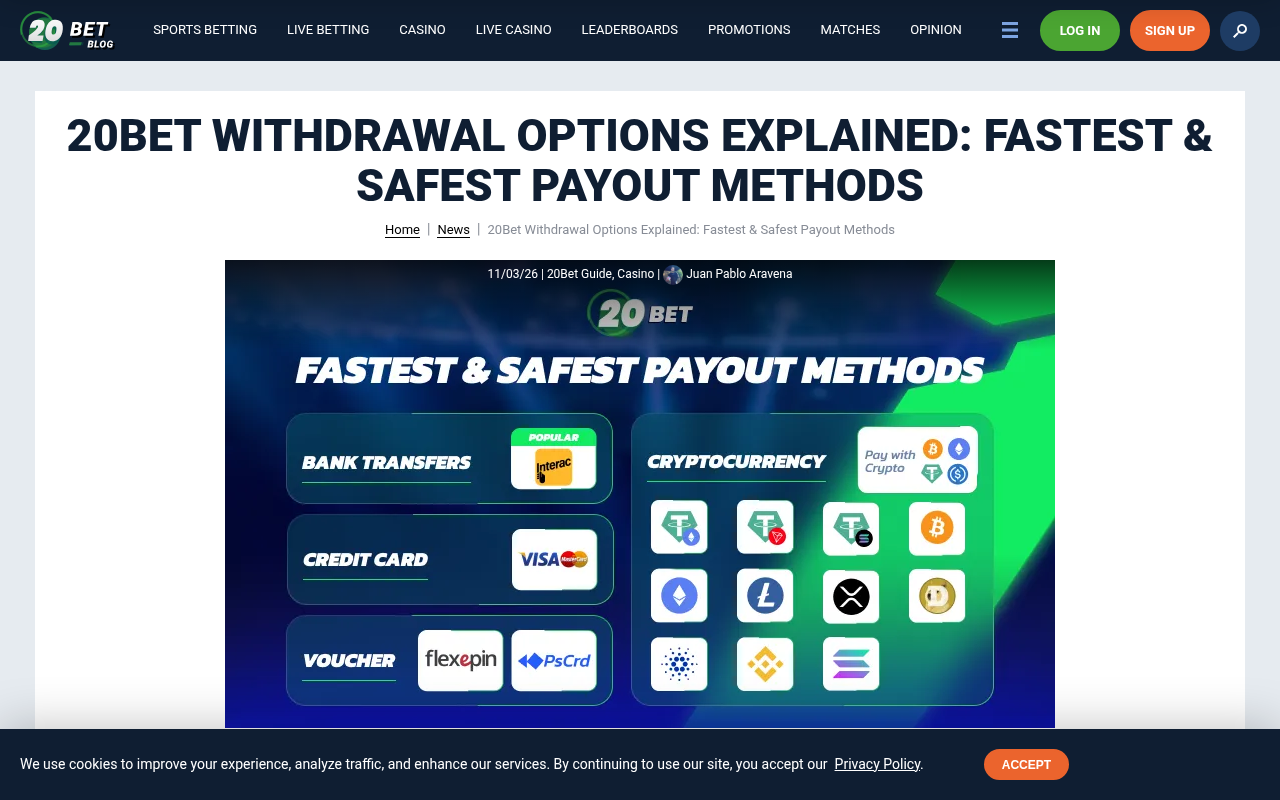
20Bet’s withdrawal guide, dated 4 August 2026, says cashout options depend on the available method and country. It describes identity verification, wagering-related checks and the possibility of delays. These are operator statements about its general process. They are useful for identifying questions to ask, but they are not independent proof that a Trinidad and Tobago resident can use a particular method or receive funds successfully.
No supported evidence identifies which cards, bank channels, digital wallets or other options appear to a local account. There is no verified minimum or maximum, fee, processing time, currency-conversion treatment or receiving-bank policy for Trinidad and Tobago. A payment logo seen elsewhere on the service should not be assumed to appear locally.
A withdrawal method may also depend on the deposit route, account verification and internal policy. The operator guide’s reference to wagering checks means a depositor should understand any applicable conditions before moving funds. It does not establish that a particular delay would be reasonable, nor does it document the resolution of any local dispute. General payment considerations are covered in the payments guide.
KYC and account eligibility are separate checks
KYC is a verification process, not a certificate of local legality. The operator says verification may form part of withdrawals, but the evidence does not show which documents it accepts from Trinidad and Tobago, when it requests them or how long review takes. A person should not assume that successful registration guarantees successful verification.
Before depositing, compare the account name with the payment-method holder, review the age and residence requirements presented during sign-up, and determine whether proof of identity, address or payment ownership may be requested. If the terms are unavailable, inconsistent or unclear, the uncertainty exists before money is committed.
Site-wide acceptance should also be distinguished from game-provider availability. An operator might permit an account while a payment provider or content supplier imposes separate geographical limits. Conversely, access to a game does not confirm that the account, deposit or withdrawal is approved for the player’s location. The evidence packet contains no provider-level territory records, so no claim about complete game access can be made.
A practical check before depositing
The most useful approach is to create a dated record before any transaction. This does not remove legal or payment risk, but it makes later questions easier to explain. Do not rely solely on chat assurances where formal terms say something different.
| Check | What to record | Why it matters |
|---|---|---|
| Exact identity | Domain, stated legal entity, terms version and any claimed licence details | Prevents evidence for another host or entity from being treated as applicable. |
| Local eligibility | Country-selection result and the written residence rule | A visible registration form alone does not prove permission to play. |
| Cashier | Methods actually displayed, currency, limits and disclosed fees | General operator guidance says choices vary by country. |
| KYC | Requested documents, upload status and dated responses | Verification may affect access to withdrawals. |
| Promotion | Accepted terms, wagering rule and expiry information | Operator guidance refers to wagering-related withdrawal checks. |
| Withdrawal | Request time, amount, method, status changes and reference numbers | Creates a clear chronology without claiming a result that has not occurred. |
| Support | Full correspondence and any reason given for a hold or rejection | Useful if a complaint must be presented accurately. |
Avoid depositing more merely because a withdrawal is pending or because support suggests another transaction will unlock funds. No such conduct is documented here as a 20Bet practice; it is a general risk-control boundary. Anyone who cannot confirm eligibility, terms and a usable withdrawal route should treat the uncertainty itself as material.
If a withdrawal or account problem occurs
Start with a factual timeline: registration date, deposit references, bonus acceptance, verification requests, withdrawal request and each response received. Preserve original emails, account messages and transaction records. Describe what happened without turning an unresolved dispute into a proven accusation.
Ask the operator to identify the precise contractual rule relied upon, the outstanding document or review step, and the expected next action. If the answer changes, retain each version. Do not send unnecessary sensitive documents through informal channels; use only the account’s documented verification route and redact information where the stated process permits.
The available records do not provide complaint totals, confirmed misconduct findings or a competent decision concerning a Trinidad and Tobago customer. A complaint would therefore remain an allegation unless supported by a dated determination or corroborated documentation. The complaints and scam warnings guide explains how to organise evidence and recognise warning signs without overstating an unresolved case.
Responsible limits under legal and payment uncertainty
Legal ambiguity and unverified cashout access increase the importance of firm limits. Gambling should not be treated as income, a way to recover losses or a solution to financial pressure. Set a spending ceiling before play, do not borrow to deposit, and stop if chasing losses or repeated payment attempts begin to replace the original plan.
If access controls, account closure or a break from gambling are needed, use the available account tools and retain confirmation of the request. Guidance on practical limits and support options is available under responsible gambling. Urgent personal or financial danger calls for immediate support rather than another deposit or wager.
An amber assessment is a reason for caution, not an invitation to test the uncertainty with money. The central unresolved points are local authorisation, account eligibility, locally displayed payment methods and an evidenced Trinidad and Tobago withdrawal outcome.
Frequently asked questions
Is 20Bet licensed in Trinidad and Tobago?
No supplied primary record identifies 20bet.com as licensed in Trinidad and Tobago. Commission material describes key licensing provisions as not yet proclaimed and says online betting is not presently contemplated under the Act. That supports an amber finding, not a claim of local approval.
Did Parliament approve online gambling for 20Bet?
No. Parliament records House approval of the Remote Gambling Order on 30 September 2026, while the supplied 2 October Senate record is an agenda listing expected debate. Neither record grants an exact-domain licence to 20Bet, and the agenda does not prove the Senate outcome.
Can a Trinidad and Tobago player withdraw from 20Bet?
The operator publishes general withdrawal guidance, but no available evidence documents a paid-out Trinidad and Tobago account. Available methods vary by country, and local cashier access, processing times, limits, fees and receiving-bank treatment remain unverified.
What can 20Bet request before a withdrawal?
Its published guide describes KYC, wagering checks, method-dependent cashouts and possible delays. The evidence does not establish the exact documents or timing for a Trinidad and Tobago resident, so account holders should rely on the written requirements shown to their own account and preserve a dated record.
Does a foreign licence make 20Bet legal locally?
No. A foreign licence, if independently verified, concerns the scope of the issuing jurisdiction. It does not by itself establish Trinidad and Tobago legality, local player eligibility or local regulatory protection. No accepted foreign licence record is included in the available evidence.
Does access to 20bet.com prove that it accepts local players?
No. A website loading, a country appearing during registration or a deposit screen being visible does not prove legal eligibility, complete game access or a usable withdrawal route. Operator, payment-provider and game-provider restrictions may differ, and no local account test is documented.